Title Deed (Tapu) Process in Turkey: A Complete Step-by-Step Guide for Foreign Buyers (2026)
The title deed process in Turkey (tapu devri) is the official legal transfer of property ownership, completed in person or by Power of Attorney at the Land Registry Office (Tapu ve Kadastro Müdürlüğü), and typically takes 1 to 3 weeks from signed contract to registered ownership. Foreign buyers receive the exact same freehold title deed as Turkish citizens, with full legal ownership rights. As a licensed real estate lawyer based in Istanbul, I handle this process regularly for international clients — this guide explains every step, every document, every cost, and every risk you need to know before you sign anything.
- What is a Tapu (Title Deed) in Turkey?
- Who Issues the Title Deed and Where?
- What Documents Do You Need for the Title Deed Process?
- Title Deed Process in Turkey: Step by Step
- How Much Does the Title Deed Transfer Cost?
- How Long Does the Title Deed Process Take?
- Can You Transfer a Title Deed Without Being in Turkey?
- What Can Go Wrong: Legal Risks to Check Before Signing
- What Happens After the Title Deed Transfer?
- Frequently Asked Questions
What is a Tapu (Title Deed) in Turkey?
A tapu is the official Turkish government document that proves legal ownership of a property, issued exclusively by the Land Registry Office (Tapu ve Kadastro Müdürlüğü). It functions exactly like a title deed or land registry certificate in any Western legal system.
The tapu is the single, definitive proof of ownership recognised by Turkish courts, banks, and government authorities throughout the title deed process in Turkey. No other document — not a sales contract, not a developer's confirmation letter, not a notarised agreement — substitutes for the tapu as proof of ownership.
Owner's full name and identification number, property address and parcel details, property type and size, any mortgages or encumbrances, and the purchase price declared at registration.
A tapu issued to a foreign national carries exactly the same legal weight and ownership rights as one issued to a Turkish citizen — full freehold, permanent, inheritable ownership.
Each independent unit — apartment, villa, or commercial space — has its own individual tapu, even within a larger building or complex.
Who Issues the Title Deed and Where Does the Transfer Happen?
The title deed is issued exclusively by the Tapu ve Kadastro Müdürlüğü (Land Registry and Cadastre Directorate), a government office with branches in every Turkish district. The transfer must be physically completed at the branch office corresponding to the property's location.
You cannot complete the transfer at a notary, a bank, or any private office. Only the Land Registry Office has legal authority to register the change of ownership during the title deed process in Turkey.
If your property is in Sarıyer, the transfer happens at the Sarıyer Tapu Müdürlüğü. If it is in Zeytinburnu, it happens at the Zeytinburnu Tapu Müdürlüğü. Each district has its own dedicated branch.
Title deed transfers in Istanbul require a pre-booked appointment, typically arranged by your lawyer 3 to 10 days in advance depending on the office's current workload.
What Documents Do You Need for the Title Deed Process in Turkey?
Foreign buyers need a valid passport, a Turkish tax number, a recent passport photo, an SPK-licensed property appraisal report, and proof of funds — the seller needs the original tapu, ID, and a debt clearance certificate. Below is the complete document checklist for both sides of the title deed process in Turkey.
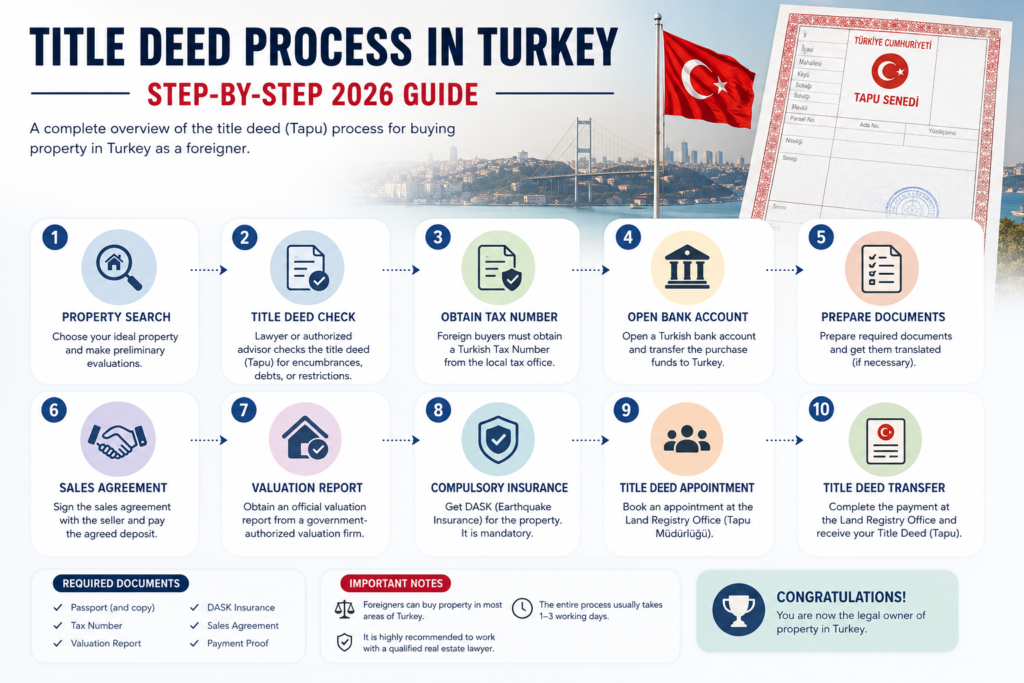
Title Deed Process in Turkey: Step-by-Step Guide
The title deed process in Turkey follows 7 sequential steps, starting with obtaining a tax number and ending with the official registration of ownership at the Land Registry Office. Here is the complete title deed process in Turkey, explained sequentially:
Visit any Turkish tax office (Vergi Dairesi) with your passport, or have your lawyer obtain it remotely via Power of Attorney. Takes approximately 30 minutes. This number is mandatory before any other step can proceed.
Your lawyer checks the property's tapu records at the Land Registry to confirm the seller's legal ownership, identify any existing mortgages (ipotek), liens, court orders (haciz), or other encumbrances that could affect your purchase.
A licensed appraisal company values the property. This report is legally required for all foreign buyer transactions and remains valid for 3 months. If pursuing citizenship by investment, the value must reach $400,000.
Buyer and seller (or developer) sign a preliminary sales contract setting out price, payment schedule, and conditions. Your lawyer reviews this before signature — it is not the title deed itself, but a binding commitment to complete the transfer.
Turkish law requires compulsory earthquake insurance (DASK) on all residential properties before the title deed transfer can be registered. This is arranged quickly and inexpensively through any Turkish insurance provider.
Your lawyer books an appointment at the relevant district's Tapu Müdürlüğü. Both parties (or their Power of Attorney representatives) must attend with all required documents.
At the appointment, the title deed transfer tax is paid, the seller and buyer sign the official transfer document before a Land Registry official, and the new tapu is issued in the buyer's name — this is the legal moment ownership transfers.
How Much Does the Title Deed Transfer Cost in Turkey?
The title deed transfer tax in the title deed process in Turkey is 4% of the declared property value, conventionally split 2% buyer / 2% seller, plus additional costs for appraisal, insurance, and legal fees that typically bring total transaction costs to 5–7% of the purchase price.
Foreign buyers purchasing new-build property and paying in foreign currency may qualify for VAT exemption — a saving of up to 18% on new developments. Eligibility must be confirmed with your lawyer before the sales contract is signed, as the exemption is structured at the time of purchase, not after.
How Long Does the Title Deed Process Take in Turkey?
The title deed transfer itself — the appointment at the Land Registry Office — is completed in 1 to 2 hours, but the full title deed process in Turkey typically takes 1 to 3 weeks from signed contract to registered ownership once all documents and funds are ready.
For off-plan or new-build purchases from a developer, the timeline can extend depending on the developer's internal processes — your lawyer will confirm the expected timeline for any specific project before you commit.
Can You Complete the Title Deed Process Without Being in Turkey?
Yes — the entire title deed process in Turkey can be completed remotely through a notarised Power of Attorney (vekaletname) granted to a Turkish lawyer, who attends the Land Registry appointment on your behalf. This remote title deed process in Turkey is the standard approach for the majority of our international clients.
You grant Power of Attorney either at a Turkish consulate in your home country, or at a Turkish notary if you visit Turkey briefly. The POA specifically authorises your lawyer to sign the title deed transfer on your behalf.
Many of our Iranian, Saudi, and Emirati clients complete their entire Istanbul property purchase — from tax number to title deed — without ever visiting Turkey until they collect their citizenship documents.
What Can Go Wrong in the Title Deed Process? Legal Risks to Check Before Signing
The most common risks in the title deed process in Turkey are undisclosed mortgages, inheritance disputes among sellers, missing habitation certificates, and developer insolvency on off-plan projects. A proper due diligence process identifies all of these before you commit funds.
Understanding these risks is essential before signing any sales contract. Below are the five issues most frequently encountered during the title deed process in Turkey, and how a lawyer resolves each one in advance.
The property may have an existing mortgage or court-ordered lien registered against it that does not appear in a casual viewing. Your lawyer checks the Land Registry record directly before any funds are transferred.
If the seller inherited the property, all legal heirs must consent to the sale. A sale signed by only one heir without the others' consent can be legally challenged after the transfer.
Properties without an official habitation certificate may have unauthorised construction or zoning violations that complicate future resale, utility registration, or citizenship applications.
For pre-construction purchases, verify the developer's financial standing, construction permits, and project completion guarantees before signing — the title deed cannot transfer until the unit physically exists and is registered.
Some sellers request declaring a lower price on the official tapu to reduce transfer tax. This is illegal, creates documentation that does not match the citizenship by investment appraisal requirement, and exposes the buyer to legal risk. Always decline this request.
What Happens After the Title Deed Transfer is Complete?
After the title deed process in Turkey is complete and you have received your tapu, you must register utilities in your name, retain the document for any future citizenship or resale process, and — if pursuing citizenship by investment — your lawyer applies for the Certificate of Eligibility within days of the transfer.
Electricity, water, and gas accounts must be transferred to the new owner's name — usually completed within a few days of the title deed transfer.
For citizenship by investment applicants, your lawyer submits the Certificate of Eligibility application to the Ministry of Environment and Urban Planning immediately after the title deed transfer.
The original tapu (or its digital record, as Turkey has largely digitised title deeds) is your permanent proof of ownership — required for any future sale, mortgage, or inheritance process.
For a full guide on the citizenship application that follows the title deed transfer, see our article: Turkish Citizenship for Iranians — Complete Investment Guide.
As a licensed real estate lawyer, I handle the complete title deed process in Turkey for foreign buyers — due diligence, appraisal coordination, contract review, and the Land Registry appointment itself. All initial consultations are free.
Title Deed Process in Turkey: Frequently Asked Questions
What is a tapu in Turkey?
A tapu is the official Turkish government title deed document, issued by the Land Registry Office, that serves as definitive legal proof of property ownership in the title deed process in Turkey — equivalent to a title deed or land registry certificate in Western legal systems.
Can foreigners get a title deed in Turkey?
Yes. Foreign nationals from most countries receive the exact same freehold title deed as Turkish citizens, with full and permanent ownership rights, subject to a small number of nationality restrictions and military zone exclusions.
How much does the title deed transfer cost in Turkey?
The title deed transfer tax is 4% of the declared property value, conventionally split 2% buyer and 2% seller. Total transaction costs including appraisal, insurance, and legal fees typically reach 5 to 7% of the purchase price.
How long does the title deed process take in Turkey?
The Land Registry appointment itself takes 1 to 2 hours. The full process from initial agreement to registered ownership typically takes 1 to 3 weeks once all documents and funds are ready.
Do I need to be in Turkey to complete the title deed transfer?
No. The title deed process can be completed entirely remotely through a notarised Power of Attorney granted to your Turkish lawyer, who attends the Land Registry appointment on your behalf.
What documents do I need for the title deed process?
As a buyer, you need a valid passport, a Turkish tax number, a recent photo, an SPK-licensed appraisal report, proof of funds, and compulsory DASK earthquake insurance. The seller provides the original tapu, ID, and a debt clearance certificate.
What is an SPK appraisal report and why is it required?
An SPK appraisal report is a mandatory, licensed valuation of the property, required for all property purchases by foreign nationals in Turkey since 2019. It confirms the official property value and is valid for 3 months.
Can the title deed transfer fail or be delayed?
Yes — common causes include undisclosed mortgages, incomplete heir consent on inherited properties, missing habitation certificates, or incomplete documentation. A thorough legal due diligence process before signing the sales contract identifies and resolves these risks in advance.
This article was written by a licensed real estate and citizenship lawyer based at Egemen Global Law Office — Skyland Istanbul, Huzur, Azerbaycan Cd. No:4 A Blok Kat:26, Sarıyer / Istanbul. Fluent in English, Turkish, Farsi, and Arabic, with extensive hands-on experience handling title deed transfers for foreign buyers in Istanbul. Last reviewed and updated on June 19, 2026.
Similar Projects in Istanbul
Explore other premium developments handpicked for investors

Seba Gardenia Zekeriyaköy
Boutique community of just 37 detached 4.5+1 villas in Zekeriyaköy's prestigious forest belt — each with a private pool and private garden.

Özak DOA Göktürk
Low-rise boutique project of 67 forest-view apartments in Göktürk — 3+1 to 5+1 units, each with a private balcony, terrace or garden.

Polat Levent Exclusive
77 boutique residences by GAD Architecture in the heart of Levent — Bosphorus views, smart home systems and private terraces.

Fua Deniz Park Tuzla
Emlak Konut GYO-backed coastal project beside Viaport Marina — 424 sea-view apartments across two phases on the Marmara coastline in Tuzla.

Ferko Line Residence Kağıthane
192 premium offices & 38 commercial units on the Kağıthane–Cendere axis — Four Points by Sheraton hotel integrated, Walter Knoll lobby interiors.

Acarkent Villa Beykoz
Istanbul's most prestigious gated villa community on the upper Bosphorus shore — 4+1 to 9+2 private-pool villas with expansive gardens in Beykoz.