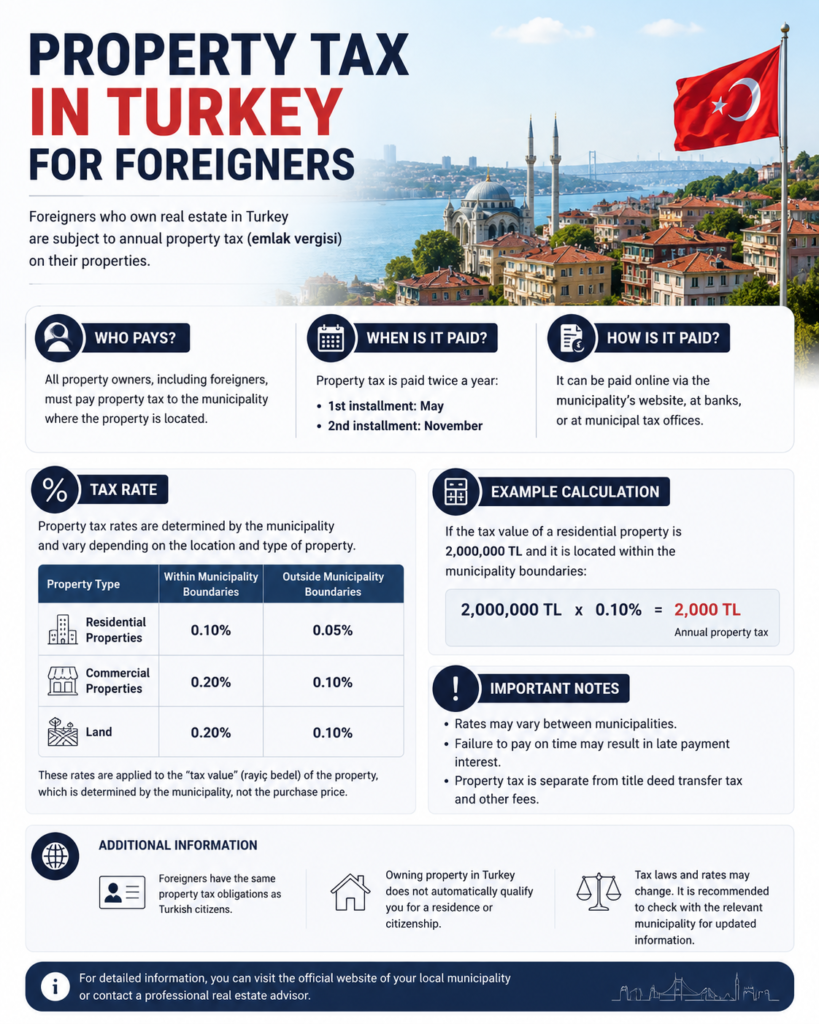
Property Tax in Turkey for Foreigners 2026: Complete Guide to Every Tax You Will Pay
Property tax in Turkey for foreigners consists of four main taxes: a one-time title deed transfer tax of 4% at purchase, an annual property tax (emlak vergisi) of 0.1%–0.6% of the registered value, rental income tax of 15%–40% on rent received, and capital gains tax of 15%–40% on resale profit if the property is sold within 5 years. Foreign buyers pay the same rates as Turkish citizens with no nationality surcharge. As a licensed real estate lawyer handling international property transactions in Istanbul, I explain every tax you will encounter — when it applies, how it is calculated, and where legal exemptions reduce your liability.
- Property Tax in Turkey for Foreigners: Overview
- Title Deed Transfer Tax at Purchase (Tapu Harcı)
- VAT on Property Purchases — and the Foreigner Exemption
- Annual Property Tax (Emlak Vergisi)
- Rental Income Tax for Foreign Property Owners
- Capital Gains Tax on Property Sales in Turkey
- Inheritance and Gift Tax
- Legal Ways to Reduce Your Property Tax Burden
- Frequently Asked Questions
Property Tax in Turkey for Foreigners: What You Need to Know First
Turkey applies the same property tax rates to foreign nationals as to Turkish citizens — there is no additional tax, surcharge, or penalty for being a foreigner. However, foreign buyers must understand the full tax timeline: taxes arise at three separate stages — purchase, ownership, and disposal — and the combined burden is manageable if planned correctly before you sign.
4% title deed transfer tax + VAT on new builds (foreigners may qualify for full exemption).
Annual property tax of 0.1%–0.6% of registered value + rental income tax if you let the property.
Capital gains tax of 15%–40% applies if sold within 5 years. After 5 years: zero capital gains tax.
If you spend more than 183 days per year in Turkey, you may be considered a Turkish tax resident and required to file a full annual income tax return covering worldwide income. Most foreign property investors who do not live in Turkey are non-residents and are taxed only on Turkish-source income (rent, gains). Confirm your residency status with a tax lawyer before purchase.
Title Deed Transfer Tax at Purchase (Tapu Harcı) — How Much Is It?
The title deed transfer tax (tapu harcı) in Turkey is 4% of the officially declared property value, conventionally split 2% paid by the buyer and 2% paid by the seller, though the split is negotiable and in practice buyers often bear the full 4%. This is the single largest property tax in Turkey for foreigners at the point of purchase and is paid on the day of the Land Registry appointment.
Some sellers propose declaring a lower value on the title deed to reduce the transfer tax. This is illegal under Turkish law, disqualifies you from the Turkish citizenship by investment programme (which requires an SPK appraisal confirming the full $400,000 value), and creates significant legal exposure. Always declare the true purchase price.
For a full breakdown of all costs at the point of purchase — not just tax — see our guide: Cost of Buying Property in Turkey 2026 — Full Breakdown.
VAT on Property in Turkey — and the Foreigner Exemption
VAT (KDV) on residential property purchases in Turkey is 1% for units under 150 m² and 20% for units over 150 m², but foreign buyers purchasing a new-build property and paying in foreign currency are fully exempt from VAT — a saving of up to 20% of the purchase price on larger units.
Residential units up to 150 m²: 1% KDV.
Residential units over 150 m²: 20% KDV.
Commercial property: 20% KDV.
Land: 0% KDV (exempt).
Foreigners who: (1) are not Turkish tax residents, (2) purchase a new-build from a developer, and (3) pay the full purchase price in foreign currency — qualify for 100% VAT exemption. The exemption must be structured in the sales contract before signing.
If you sign the sales contract without VAT exemption language, you cannot claim it afterward. Always confirm VAT exemption eligibility with your lawyer before signing any developer contract. This exemption alone can save $50,000–$200,000 on higher-value properties.
Annual Property Tax in Turkey (Emlak Vergisi) — Rates and Payment
Annual property tax in Turkey (emlak vergisi) ranges from 0.1% to 0.6% of the property's registered tax value (vergi değeri), which is typically significantly lower than the actual market value, making the annual tax burden very low relative to property values.
Annual property tax is paid in two equal instalments — the first instalment in May, the second in November. Payment is made to the municipality (belediye) where the property is located.
A $400,000 apartment in Istanbul: the registered tax value is typically $60,000–$120,000. Annual tax at 0.2% = approximately $120–$240 per year — a very low burden relative to the asset value.
Note: The registered tax value (vergi değeri) is reassessed by the municipality periodically and is always substantially lower than market value. Your actual annual tax bill will be provided by the relevant district municipality after the title deed transfer is registered.
Rental Income Tax for Foreign Property Owners in Turkey
Foreign nationals who earn rental income from Turkish property must pay Turkish income tax on that rental income at progressive rates of 15% to 40%, but an annual rental income exemption threshold means the first portion of residential rental income is tax-free.
*USD equivalents approximate at 36.5 TL/USD. Rates and thresholds are for 2026 tax year and subject to annual revision.
Residential rental income below the annual exemption threshold (33,000 TL for 2026) is fully tax-free and requires no tax filing. Most short-let investors in Istanbul exceed this threshold within the first month of renting.
Property management fees, maintenance costs, mortgage interest (if applicable), insurance premiums, and depreciation can all be deducted from gross rental income before calculating tax — reducing the effective rate substantially.
Istanbul residential properties typically yield 4%–7% gross annually depending on location and management. After property tax in Turkey for foreigners, net yields for foreign investors typically remain 3.5%–6% — strong by European standards for a city of Istanbul's size and growth trajectory.
Capital Gains Tax on Property in Turkey — The 5-Year Rule
Capital gains tax on property in Turkey applies only if you sell within 5 years of purchase — if you hold the property for more than 5 years, the gain is completely exempt from tax. This is one of the most favourable capital gains rules for property investors anywhere in Europe or the Middle East.
Sale price minus the inflation-adjusted original purchase price (the Turkish tax authority adjusts the cost base for official inflation each year, which substantially reduces the taxable gain). Legal fees and improvement costs can also be deducted.
An annual capital gains exemption of 87,000 TL (approximately $2,400) is deducted from the net gain before tax is calculated. This reduces the taxable base slightly but is most beneficial for smaller gains.
The remaining taxable gain is taxed at the same progressive income tax rates as rental income: 15% to 40%, depending on the size of the gain in that tax year.
If you hold the property for more than 5 full years from the date on the title deed, the entire capital gain is exempt from tax — regardless of the size of the gain. This rule strongly incentivises medium-term property investment in Turkey.
If you purchased property to obtain Turkish citizenship by investment, there is a separate 3-year resale restriction — you cannot sell the property for at least 3 years from the date of citizenship approval. This is distinct from the 5-year capital gains tax exemption: you can sell between years 3 and 5 and pay capital gains tax, or wait until year 5 and sell tax-free.
Inheritance and Gift Tax on Property in Turkey
Turkish inheritance and gift tax on property ranges from 1% to 30%, applied to the registered tax value (not market value) of the property, with progressive rates that increase based on the value inherited and the relationship between donor and recipient.
Rates range from 1% (on values up to approximately 1.5M TL) to 10% (on values above 7.1M TL), applied to the registered municipal tax value of the property — typically 20%–30% of market value — making the effective rate on market value very low.
Gifts between living persons are taxed more heavily: rates range from 10% to 30% of the registered value. Gifts to direct family members (spouse, children, parents) qualify for reduced rates. Structuring property transfers as inheritance rather than gift is often more tax-efficient.
Foreign nationals who inherit Turkish property are subject to Turkish inheritance tax in the same way as Turkish citizens. The estate must file a Turkish inheritance tax declaration within 3 months of the death. A Turkish lawyer can handle this process remotely on behalf of foreign heirs.
Legal Ways to Reduce Property Tax in Turkey for Foreigners
The most impactful legal tax reductions available to foreign property owners in Turkey are: claiming the VAT exemption at purchase, holding for 5+ years to eliminate capital gains tax, deducting all allowable expenses from rental income, and ensuring the registered tax value reflects the correct municipal assessment.
If you are buying a new-build and paying in foreign currency, confirm VAT exemption eligibility with your lawyer before the sales contract is signed. This is the single largest tax saving available and cannot be claimed retroactively.
If your exit timeline allows, holding the property for over 5 years eliminates capital gains tax entirely — regardless of the profit made. For citizenship investors with a 3-year minimum hold, the additional 2 years to reach the tax-free threshold is a low-cost decision.
Property management fees, maintenance, insurance, mortgage interest, and depreciation are all deductible against rental income before tax is calculated. Keep records of all expenditure from day one of ownership.
Turkey's high inflation means the cost base of your property is adjusted upward annually by the official inflation rate when calculating capital gains tax. In high-inflation years, this adjustment can eliminate most or all of the taxable gain even on a profitable sale within 5 years.
Our licensed real estate lawyers advise foreign buyers on the full tax structure before purchase — VAT exemption eligibility, capital gains planning, rental income optimisation, and citizenship by investment compliance. All initial consultations are free.
Property Tax in Turkey for Foreigners: Frequently Asked Questions
Do foreigners pay more property tax in Turkey than Turkish citizens?
No. Turkey applies identical property tax rates to foreign nationals and Turkish citizens. There is no additional surcharge, penalty, or different rate for foreign buyers at any stage — purchase, ownership, or sale.
What is the annual property tax rate in Turkey?
Annual property tax (emlak vergisi) for residential property in Istanbul is 0.2% of the registered municipal tax value — which is typically 20%–30% of actual market value. The practical annual tax burden on a $400,000 property is usually $120–$250 per year.
Can foreigners claim VAT exemption when buying property in Turkey?
Yes — foreign buyers who are not Turkish tax residents, purchase a new-build from a developer, and pay the full price in foreign currency qualify for full VAT exemption. The exemption must be structured in the sales contract before signing and cannot be applied retroactively.
Is there capital gains tax on property in Turkey?
Yes, if you sell within 5 years of purchase. The gain is taxed at progressive income tax rates of 15%–40% after inflation adjustment of the cost base and an annual exemption threshold. If you hold for more than 5 years, the entire capital gain is tax-free.
How is rental income taxed for foreign property owners in Turkey?
Rental income from Turkish property is taxed at progressive rates of 15%–40% after deducting allowable expenses (management, maintenance, insurance, depreciation). Residential rental income below approximately 33,000 TL per year is exempt from tax and requires no filing.
Do I need to file a Turkish tax return as a foreign property owner?
Non-residents with rental income above the exemption threshold must file an annual Turkish income tax return. Non-residents with only annual property tax obligations do not need to file — the municipality bills them directly. A Turkish tax accountant or lawyer can handle filings on your behalf remotely.
What is the property transfer tax in Turkey?
The title deed transfer tax (tapu harcı) is 4% of the officially declared property value, conventionally split 2% buyer and 2% seller, though the split is negotiable. It is paid on the day of the Land Registry appointment.
Does Turkish citizenship by investment affect my tax obligations?
Obtaining Turkish citizenship does not automatically make you a Turkish tax resident — residency for tax purposes depends on physical presence (183+ days per year). However, the 3-year resale restriction on the citizenship property and the 5-year capital gains tax exemption must both be factored into your exit planning.
This article was written by a licensed real estate and citizenship lawyer based at Egemen Global Law Office — Skyland Istanbul, Huzur, Azerbaycan Cd. No:4 A Blok Kat:26, Sarıyer / Istanbul. Fluent in English, Turkish, Farsi, and Arabic, with extensive experience advising foreign nationals on property tax planning in Turkey. Last reviewed and updated on June 25, 2026.
Similar Projects in Istanbul
Explore other premium developments handpicked for investors

Seba Gardenia Zekeriyaköy
Boutique community of just 37 detached 4.5+1 villas in Zekeriyaköy's prestigious forest belt — each with a private pool and private garden.
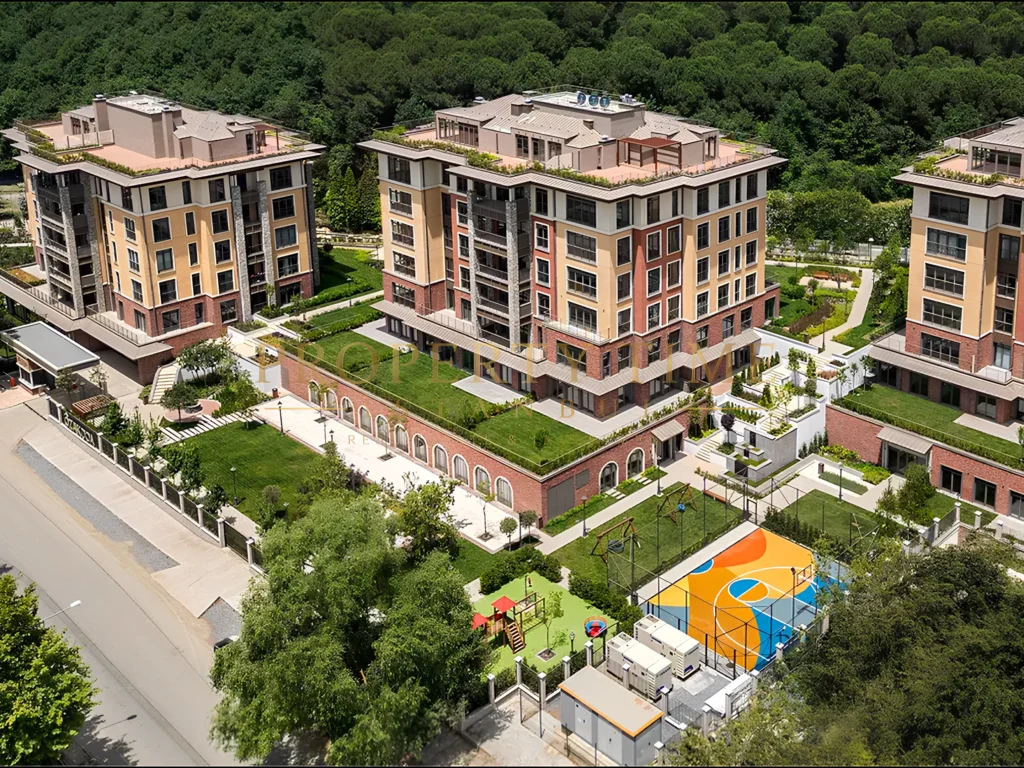
Özak DOA Göktürk
Low-rise boutique project of 67 forest-view apartments in Göktürk — 3+1 to 5+1 units, each with a private balcony, terrace or garden.

Polat Levent Exclusive
77 boutique residences by GAD Architecture in the heart of Levent — Bosphorus views, smart home systems and private terraces.

Fua Deniz Park Tuzla
Emlak Konut GYO-backed coastal project beside Viaport Marina — 424 sea-view apartments across two phases on the Marmara coastline in Tuzla.

Ferko Line Residence Kağıthane
192 premium offices & 38 commercial units on the Kağıthane–Cendere axis — Four Points by Sheraton hotel integrated, Walter Knoll lobby interiors.
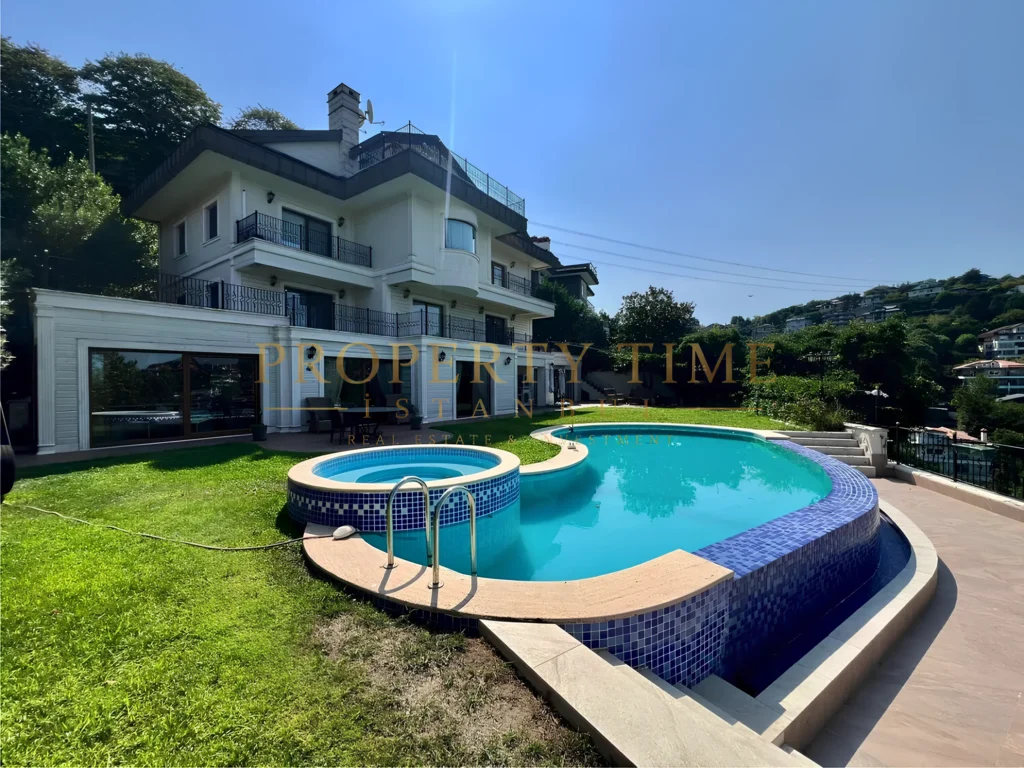
Acarkent Villa Beykoz
Istanbul's most prestigious gated villa community on the upper Bosphorus shore — 4+1 to 9+2 private-pool villas with expansive gardens in Beykoz.